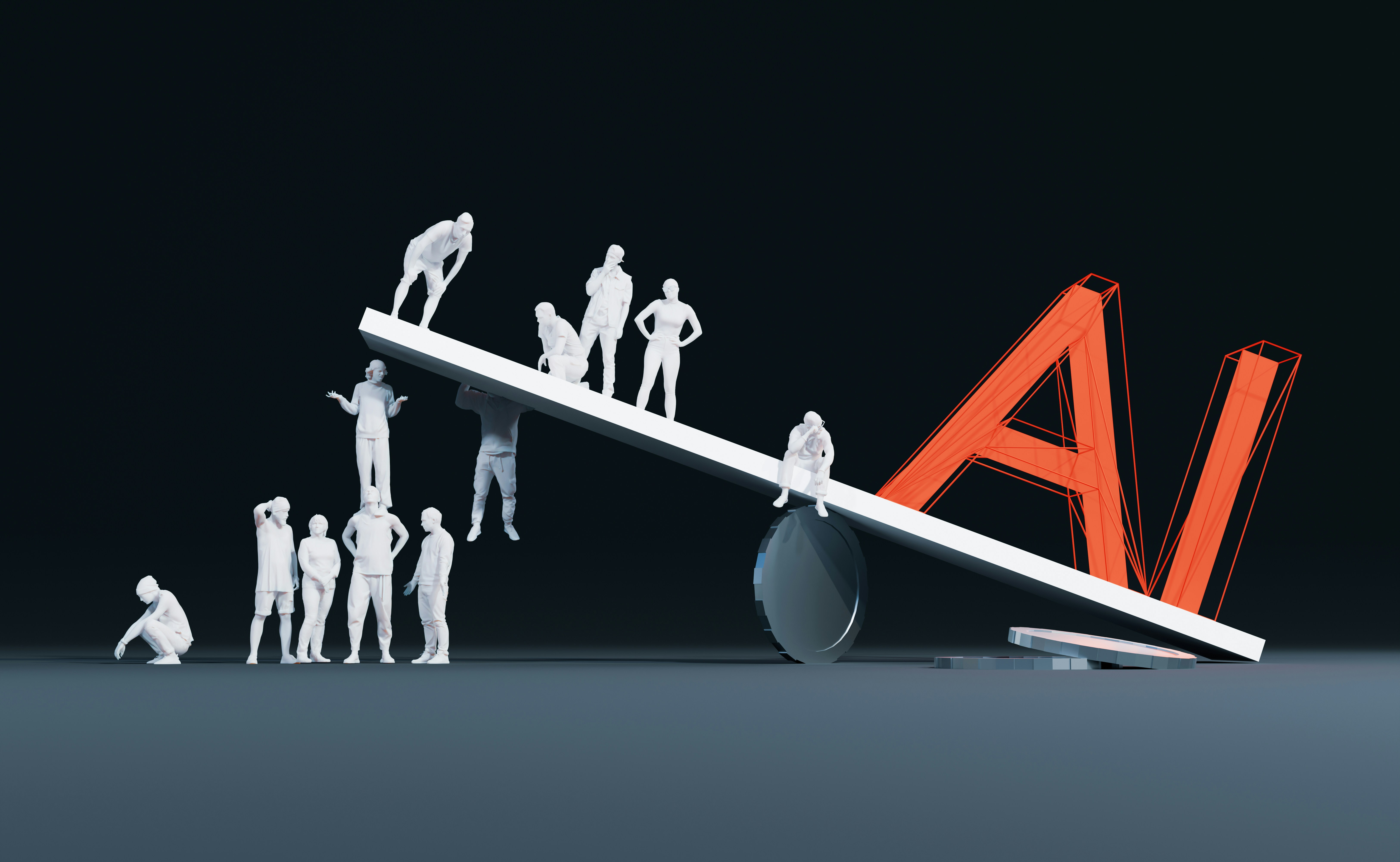

Plans Break. Policies Hold.
Why a decade of better predictions hasn't made supply chains more resilient — and what changes if we optimize the policy instead of the plan.
It's Tuesday, 8:42 AM. Your most experienced planner has been at her desk for forty-three minutes. The overnight MRP run dropped 412 new exception messages into her inbox. A supplier note at 9:14 — delayed shipment due to quality issues, ETA shifted by nine days. By 9:31, sales asks if a customer pull-in for Friday is feasible. By 9:55, the CFO is asking why expedite freight is up eighteen percent this month.
At no point on that timeline is your planner planning. She's reacting.
We have spent a decade getting better at predicting supply chains. Forecast accuracy has lifted materially across most industries. AI-augmented demand sensing has matured beyond the buzzword stage. End-to-end visibility through control towers has gone from aspiration to standard. By every measure of "predictive or visibility capability," supply chains are more sophisticated than they have ever been.
And yet that Tuesday morning at 8:42 hasn't gone away. The war rooms haven't gone away. The CFO's question about expedite spending hasn't gone away. The gap between predicting / seeing and choosing — between what a system can see and what an organization can decide to do about it — has barely closed.
This is the conversation I want to have here, before I get on stage at NextGen SCM Delhi on May 8. Because I think the next decade of supply chain transformation isn't going to be about better predictions. It's going to be about better decisions.
We've made supply chains predictive. We haven't made them decisive.
The investments most enterprises have made in supply chain technology over the past decade sort into a handful of buckets: better forecasting, better visibility, better integration, and a growing layer of AI/ML on top of all three. These investments have produced real value. I'm not arguing they shouldn't have been made.
But there is a quiet ceiling we've all run into. Better forecasts don't produce better decisions. Better visibility doesn't prevent stockouts. AI-augmented S&OP doesn't reconcile sales, supply chain, and finance — it just gives them better-formatted inputs to argue over.
The reason is that we've layered intelligence on top of a planning architecture that was designed for a more predictable world. The architecture itself — sequential, single-future, master-data-driven, single-objective — has not changed. We've made the inputs to that architecture much better. But the architecture is what's failing under stress.
If you've ever sat in an S&OP meeting where five disconnected plans had to be reconciled in 48 hours by argument, you've seen this. If you've ever watched a "self-healing" supply chain produce an alert that requires three humans and a Teams call to resolve, you've seen this. If your planning team buffers inventory everywhere because nobody trusts the master data anymore, you've seen this.
The problem isn't that the predictions are wrong. The problem is that even with the right predictions, the decision quality remains poor. There are six specific reasons. I want to walk through each.
1. Sequential, single-future planning.
Most planning systems still solve the problem in five sequential stages: pricing → demand → supply → inventory → finance. Each stage assumes the prior one's output is fixed. Each stage adds its own assumptions. Each stage loses information when it hands off to the next.
The result: every monthly S&OP cycle ends with five plans that don't agree, reconciled in the last 48 hours of the month by whoever is loudest in the meeting. The CFO commits to numbers nobody can defend operationally. The pricing team makes decisions in a different room from the supply team. The inventory plan was built on a static safety-stock formula that nobody has reviewed in two years.
There is a better architecture. It's not new — operations researchers have argued for it for decades — but until recently the compute and the math weren't there. A single-pass joint solve treats demand sensing, supply sensing, demand shaping (price/promo) in response to demand & supply sensing), supply optimization, inventory positioning, and financial alignment as one math problem. One model. One run. Demand and supply move together. Pricing decisions affect what gets produced; production constraints affect how it gets priced. The forecasted P&L, balance sheet, and cashflow come out of the same plan that runs the floor.
The first shift is architectural. Stop solving the problem in five stages. Start solving it as one.
2. Stale master data dressed up as single-value assumptions.
Walk into the planning office of nearly any enterprise and ask a senior planner whether they trust the supplier lead time field in their ERP. The answer is almost always some version of "not really." A lead time of 14 days was set in 2023. Nobody has reviewed it. Variability around that 14 days — sometimes 10, sometimes 21, sometimes 28 — is invisible to the system. The plan uses 14. Reality uses something else entirely. Some planners go the other extreme by putting hugely padded lead time values, which drives excess inventory and working capital inefficiency.
Same with scrap rate. Same with capacity. Same with demand forecast — which is almost always a mean, with no shape, no tail.
Once your planning team stops trusting the master data, they buffer everywhere. Safety stock goes up. Cycle stocks go up. Working capital gets trapped in inventory nobody can defend on a balance sheet review. And the buffer doesn't even fix the problem — when reality drifts to the tail when risk shocks like Strait of Hormuz closure hit, the buffer wasn't sized for the tail, so the stockout still happens. Now you're carrying excess inventory AND missing service.
The fix isn't better static parameters. It's giving up on static parameters altogether. Every input driver has a distribution, learned from your own transaction history. Lead times are shapes, not numbers. Scrap rates are shapes. Demand is a shape. The planning system uses the shapes — and lets the planner choose how much of each shape to plan against.
That choice is the next problem.
3. No order-line margin awareness at decision time.
Picture this. Tuesday afternoon, 14:32. A customer pulls 1400 units of your highest-velocity product, requested for delivery on Friday. Your forecast called for 800. The order is two weeks inside lead time. Sales says yes — great account, relationship deal, good price. The planning system, asked to fulfill at any cost, says yes too. OTIF is the metric the planner is measured on. The system chases service.
By the time finance reconciles the month, the cost-to-serve on that order tells a different story. There was expedite freight to substitute the mode from ship to air to fit the lead time. There was overtime in the plant as well as excessive changeover costs. There was churn on the Suppliers. There were higher-margin orders that got crowded out and missed their commitment. None of that was visible at the moment the order was accepted. Standard COGS was used. The order looked profitable. It wasn't.
This pattern repeats across most enterprises I see. Single-objective optimizers chase service-level KPIs because that's how the system was set up. Margin lives in finance reports, weeks behind operations. Working capital lives somewhere else entirely. By the time the trade-off shows up, it's already happened.
A multi-objective optimizer sees service AND margin AND cash AND carbon at the same time, on the same plan, on every order line. When margin would breach the floor, the system flags it before the order is accepted — and recommends a surcharge sized to the actual cost-to-serve. Sales gets a real-time signal, not a quarter-end surprise. Commercial discipline becomes a planning constraint, not a finance after-the-fact report.
4. No explicit risk posture.
Every supply plan implicitly chooses how much variability to cover. The choice is real, the dollars are real, and yet the choice itself is almost never made consciously, by name, by a person in authority.
Consider what happens today. A planner, deciding safety stock for an SKU, picks a number — let's say two weeks of cover. Why two? Because that's what was set last year. Why was it set last year? Because someone tried 1.5 weeks and ran out of stock once. The choice is buried in a static parameter nobody owns and nobody has touched in months. But that choice is doing real work — it's the difference between a stockout this week and excess inventory next quarter. It's worth millions of rupees across a network. And it's invisible.
What if the choice were explicit? What if the CSCO / COO / CFO literally chose between three named postures — Conservative, Balanced, Lean — each carrying explicit floor/ceiling commitments on every input driver? How much demand variability to cover. How much lead-time variability to cover. What the margin floor is. Which risk events to plan against — and at what probability.
Conservative covers the tail at the cost of more inventory. Lean runs for cash with sharper exposure to shocks. Balanced finds the middle. Each is named. Each is dollarized. Each is a deliberate choice that surfaces explicitly at the leadership level.
This is what I mean by a decision policy. It's not a planning parameter. It's a posture to convert uncertain environments into resilient recommendations for action. And in most organizations today, that posture is being chosen by default, not by design.
5. No optimization of the policy itself.
We've spent thirty years optimizing supply plans. We've built sophisticated software to find the plan that minimizes cost or maximizes service or balances some weighted combination of both. None of it has been wrong. All of it has been incomplete.
Because under uncertainty, the question isn't which plan is optimal. The question is which policy is optimal — across the range of futures we might actually face.
Two policies running against the same uncertainty produce two distributions of outcomes. One might deliver more in expected NPV than the other across a thousand simulated futures, after accounting for tail risk and downside variance. That delta — the dollar value of choosing one posture over another — is what I call Policy Value Add. It's a number. It's defensible. It's something the CFO can explain to the Board.
Meta-optimization is the math that finds the policy on the Pareto frontier where enterprise value is maximized. The argument that used to happen in S&OP meetings — should we run lean or run safe? — becomes a math result. The answer might still be "Conservative for Region A, Lean for Region B." But the answer is computed, not debated.
We've optimized plans for three decades. We've barely begun to optimize policies. That's the layer almost no enterprise has actually understood the value of yet — and where the next ten years of supply chain ROI is going to come from.
6. No stress-testing of the decision before commit.
The plan you commit to today is a single best guess at the future. Tomorrow, when reality differs from the guess, the war room starts. The post-mortem starts. The finger pointing starts.
What if the plan you committed had already been tested against everything you fear? What if before signing it, you saw it play out across a thousand simulated futures — with promo spikes, supplier delays, weather shocks, aggregator algorithm changes, named risk events firing at their actual probabilities — and you knew exactly which combinations broke it and which it absorbed?
I call this time travel. Lookahead. Decision Resilience Test — pick the term you like. The principle is the same: stress-testing is something that should happen before you commit, not after the shock has already cost you.
When the plan you sign has already been simulated forward across the full variability + risk spectrum, the conversation in the boardroom changes. The CFO can answer questions about resilience with numbers, not narratives. The supplier gets a stable order signal because the plan was designed to absorb the named shocks. The planner stops being graded on what reality threw at her and starts being graded on whether the policy she chose held up under routine variability to deliver balanced outcomes across competing objectives.
Most planning systems today don't even attempt this. The compute exists. The math exists. What's missing is the deliberate architecture choice to put stress-testing inside the decision loop, not outside it.
From plans to policies.
If you take all six of these together, what falls out is a fundamentally different way of thinking about supply chain decisions.
Stop optimizing for one future. Start choosing a policy.
A policy is a deliberate posture toward uncertainty — defined by you, tested across thousands of futures, expressed in dollars. Same supply chain. Different posture. Defensible numbers.
Under this approach, the roles change:
The planner stops chasing 95% forecast accuracy. She starts choosing how much demand variability to cover, on which SKUs, in which clusters — and her time stops being spent on exception-clearing and starts being spent on shaping the posture.
The CSCO stops asking "what's our supply plan for Q3" and starts asking "which policy are we running, and what's its expected NPV across the futures we're planning against?"
The CFO stops learning about cost overruns at month-end. She sees the dollar value of the chosen posture before it's chosen — and can defend the trade-offs to the board with math, not narrative.
The supplier stops getting a stream of mindless pull-ins and push-outs. He gets a stable order signal that comes from a plan with built-in churn discipline.
This is what I mean when I say predictive supply chains have plateaued. The next decade isn't about predicting more accurately. It's about choosing more deliberately.
We’ve been building toward this architecture with VYAN — combining stochastic optimization, granular cost-to-serve modeling, and policy-level decisioning — and the early results are clear.
What this means for you.
Last week at SChainXpo Mumbai conference, I had the privilege of sharing some of these ideas with two hundred supply chain leaders. The conversations at the booth and post the conference is where the real work happened. What I heard, again and again, was that CSCOs and SC VPs intuitively know all of this already. They've felt the limits of predictive and visibility centric supply chain plays in their bones — every quarter-end, every shock, every war room. What they're missing is the math, the platform, and the language to make the leap from better predictions/visibility to better decisions explicit and defensible.
I'll be on stage at NextGen SCM Delhi conference on May 8th, going deeper on what this looks like in practice — including how decision intelligence and stochastic optimization work in the trenches. If you're attending, I'd love to continue the conversation — find me before or after my session.
And if you're not attending but your organization is wrestling with volatility, inventory bloat, service trade-offs, or planning instability despite major investments in forecasting and visibility — I believe this is one of the most important shifts supply chain leaders should be thinking about over the next few years. Reply to this newsletter, message me directly on LinkedIn, or just push back. The more I work in this space, the more convinced I am that we're at the edge of a real shift in how supply chain decisions get made — and the leaders who recognize it first are going to have an outsized advantage in the next cycle.
The plan you're optimizing today will break. The policy you choose should hold.
Onwards.