
The plan was built on averages. Your business never runs on them.
Planning systems reduce uncertain demand, supply, lead times, yields, and capacity to single numbers, then optimize a version of your company that rarely shows up. The gap costs service, margin, and cash every cycle. VYAN plans across the real range of your business and shows what each choice protects and what it costs, before you commit.
Does your planning process recognize this business?
A plant is rated at 1,000 units a day. Planning learned long ago to use 700, because that is the historical average. Most weeks the operation runs near 900. Some weeks it runs near 500. Nobody, in any week, runs the average.
The number is not mathematically wrong. The mistake is treating 700 as the world the business will operate in. Every number downstream, the safety stocks, the promise dates, the buffers, the budget, inherits the fiction. Multiply by every driver in the network and you have a plan that is precise, defensible, and wrong.
Service. Margin. Cash. Growth.
The gap between the planned average and the lived range does not arrive as a crisis. It arrives as working capital that creeps up while service creeps down, expedites that became a department, write-offs nobody can trace to a decision, and a plan everyone adjusts by hand because nobody believes it. Averages are useful descriptions. They become dangerous commitments when the variability around them determines the economics. Added up, those commitments determine enterprise value.
Built from three decades inside global planning transformations.
VYAN founder Ashutosh Bansal led supply chain practices at PwC, IBM, and SAP, with transformation work spanning global enterprises in high tech, consumer, industrial, and energy. VYAN exists because the paradigm he helped scale is no longer the right one.
Meet the founder →The argument, in three short clips.
The 17% Reframe
Why fewer than one in five supply chains are transforming with AI, and the real reason the others hold back.
Two Engines: Risk Diagnostics & Resilience Optimization
The whole category in two minutes: see every future, then commit one plan that survives them.
Healthy Averages, Margin Bleeding Underneath
A live look: the dashboard is green, until you drill into the customer quietly losing money.
The forecast was never the problem. The paradigm underneath it is.
Forecasts are sharper than they have ever been. Control towers light up in real time. Network visibility has never been clearer. And the Tuesday firefight is still on the calendar.
That is not a failure of the forecast. However sharp the number, it still feeds a planning paradigm built for a more predictable world, one that commits to a single future, optimizes each silo in turn, and decides from parameters set months ago. A better input into a brittle pass is still a brittle pass.
This is not a signal problem. It is a decision problem.
A System of Intelligence, above the system of planning and the system of record.
Your ERP is the system of record: what is true. Your planning suite is the system of planning: what the plan says. Neither was built to answer the question an executive actually owns: given everything that could happen, what should we decide? That is a third layer, the , and it sits above both.
At its core is the : a continuously- calibrated model of how your enterprise decides. Two engines run on it, and they share one scenario set, so the diagnosis and the commitment never drift apart.
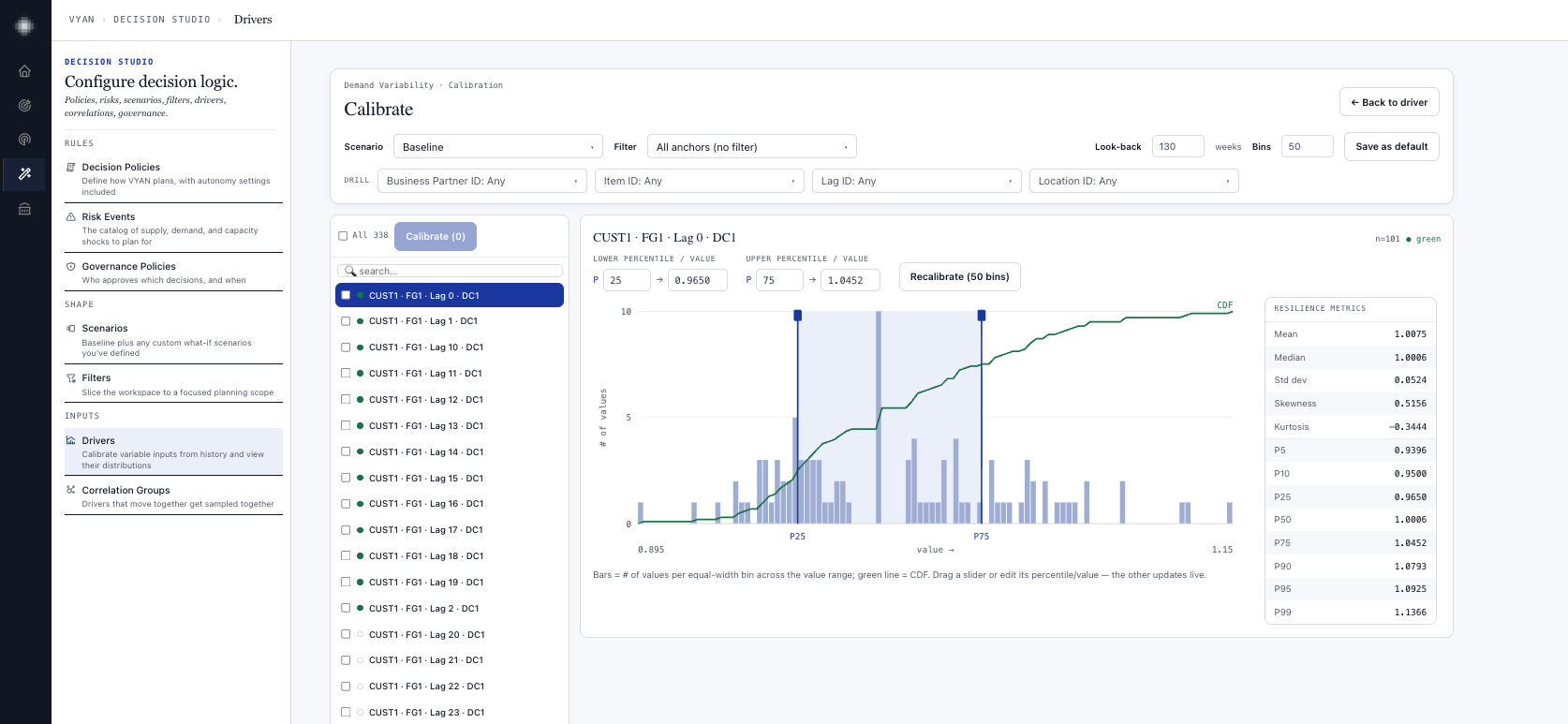
Learns every driver, from lead time to demand to yield to cost, as a distribution, then maps the spectrum of futures and what each one does to your KPIs.
Commits one plan that holds across hundreds of those futures, pricing the cost of resilience into the decision instead of into blanket safety stock.
Plan against the shape, not the average.
VYAN learns how your drivers actually behave from your own history, evaluates decisions across hundreds of plausible futures, and commits the one plan that holds across the range you choose to protect.
Stop typing in what should be computed.
Safety stocks, lead times, yields, and buffers stop being numbers a planner maintains by hand and become outputs of the solve, continuously calibrated against reality.
Your ERP and planning systems keep their jobs. VYAN is the decision layer above them, not another planning system. See how it works →
Resilience becomes a line item, not an argument.
VYAN shows leadership the ideal plan, the committed plan that holds your floors, and the priced gap between them, so the enterprise buys its protection deliberately instead of inheriting it from ten thousand typed-in numbers.
All three matter. But autonomy without resilience is just faster risk.
A·I·R is three properties of a decision you can trust: Autonomous where it counts, Integrated across functions (cross-functional, not system integration), and Resilient to uncertainty.
Gartner surveyed 140 senior supply-chain leaders and found only 17% are pursuing transformational redesign of how they plan. The other 83% are applying AI incrementally. In the same breath, Gartner calls future agentic orchestration across the end-to-end network the destination. So the future is autonomous, and four in five aren’t moving toward it. The stated reasons, data readiness, upskilling, fragmented vendors, are symptoms.
The cause: planning is brittle and fed by stale ERP data, held together by planners absorbing the shocks by hand. Point “autonomous” at that and it just commits the mistakes faster, promising a date off a single lead-time number whose real distribution says you lose the coin flip, while chasing a service commit blind to the margin it just broke in the next function. Resilient and Integrated aren’t two features; they’re one requirement: make each decision robust to uncertainty, and robust across service, margin and cash at once, and only then let the agents run. The 83% aren’t behind. They’re being careful for a reason most can’t yet name.
Source: Gartner, “AI Is Not Driving Supply Chain Operating Model Transformation,” May 2026
A
Autonomous
Powerful, but only as safe as the decisions beneath it.
Routine moves, rebalancing, risk flagging and in-policy adjustments, happen at the function that owns them, inside the bounds of the Decision Policy, so people are freed for the calls that need them.
I
Integrated
Cross-functional, not system-integrated.
Procurement, production, transport, inventory and commercial solve together, so a demand pull-in cannot quietly break a margin floor in a function that never saw it coming.
R
Resilient
The foundation: where VYAN goes deep today.
Variability is calibrated from your actual history, not assumed away. Every decision is scored before commit, and tail cost is priced into the objective, not noticed in the post-mortem.
Five layers, from the data lake to the boardroom.
ERP, APS, MES, PLM and the rest: the systems of record, read as they are.
A versioned, typed model of how your enterprise actually decides.
Where drivers are calibrated and the Decision Policy is authored.
Where decisions are emitted, governed, sensed, and re-solved as the world moves.
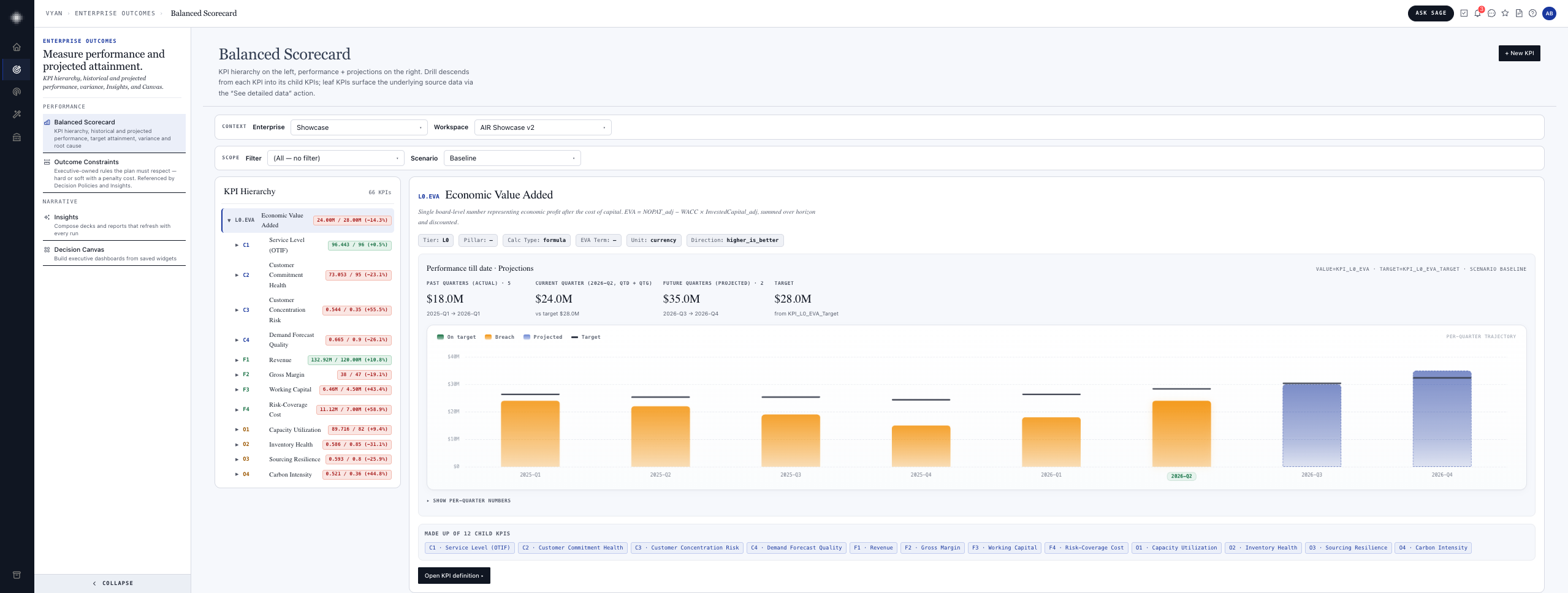
The balanced scorecard: the only layer that prices uncertainty into the number.
If you own the P&L
You approve the working capital and you eat the variance. VYAN makes the uncertainty behind every planning commitment financially explicit: what protection costs, where conservatism is tying up cash, and where the downside justifies it.
Why VYAN →If you own the operation
Your network runs on parameters nobody has recalibrated in years, and every disruption becomes a war room because the plan only considered one future. VYAN commits plans that already survived the futures you worry about.
Why VYAN →If you own the process
Five plans that do not agree, reconciled in the last 48 hours of the month by whoever argues loudest. VYAN replaces the negotiation with math and makes the trade-offs explicit before the meeting.
Why VYAN →If you own the architecture
A decision layer above your stack, read-only against your data, no rip-and-replace. Planners govern policy instead of maintaining ten thousand numbers by hand.
Platform →Decisions architected across enterprises in semiconductor, pharma, industrial, apparel and energy.
Engagement themes from work led by the VYAN founder: freed working capital, less expediting, service held through disruption, now refined as the VYAN system. Qualitative by design; the vertical fit lives in Industries.
Transformation experience behind VYAN. Not yet VYAN customers; we earn those on your data, not on a slide.
Demand-supply resilience
Lead-time variability priced into safety stock, not into the planning solve. Expedite freight running 18% over budget. Senior planners attriting at 22% annually.
Architected a probabilistic supply substrate that priced lead-time variability into the planning solve and surfaced supplier risk as a learned distribution per lane.
Reduced expediting spend; freed working capital.
Multi-site production optimization
Sequential plant-by-plant scheduling that lost the network optimum at every handoff. Sub-optimal sequencing absorbed in changeover costs and rework.
Replaced sequential plant-by-plant scheduling with concurrent multi-horizon optimization across the network. Sequence-stability as a measured cost the policy weighed.
Network-level throughput up; changeover scrap down; planner confidence restored.
Inventory and allocation intelligence
Safety stock sized by formula; seasonal and promotional cycles never priced in. Stockouts on Tier-A customers; markdowns on tail SKUs at quarter-end.
Built driver-based safety stock policies that adapted to seasonal-promotional cycles. Multi-echelon optimization sized buffers to actual variability per node.
Working capital reduced; Tier-A service up; markdown exposure down.
Days to a business case, not months to slideware.
PULSE is a short, guided diagnostic. We score your enterprise on resilient-decision capability, against the single-future paradigm your peers still run, and walk you to a value estimate grounded in your own public financials. Remote or on-site. No fee, no deck.
A healthy enterprise breathes through every layer.