
Why Resilience Has to Come Before Autonomy
A full recap of our launch session, the R of A·I·R, and the argument behind a new category: resilient decisions.
Gartner recently surveyed 140 Chief Supply Chain Officers. Only 17% are using AI to genuinely transform how they plan. Fewer than one in five. The other 83% are holding back: running point use cases, scaling cautiously.
The explanation the industry reaches for is familiar: the data isn't ready, people need upskilling, the vendor landscape is fragmented. Every one of those is real. We think every one of them is a symptom.
In our launch webinar last week, we made the case for what's actually underneath, and why the rush to automate supply chain planning with AI is, for most companies, a mistake of sequence. This is the recap. If the argument lands, the full session and deck are on our site.
The real cause nobody wants to name
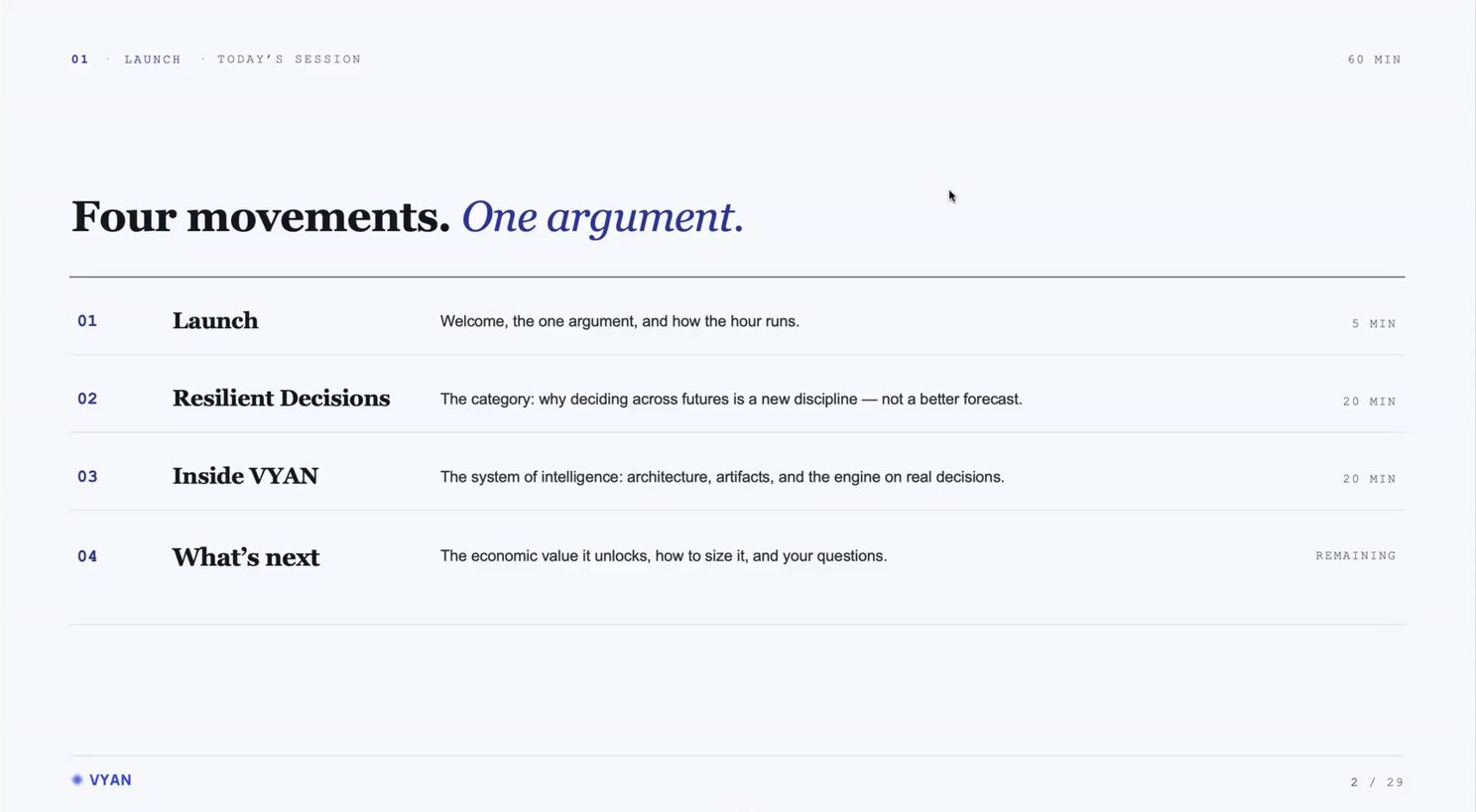
Underneath the stated reasons sits a brittle planning paradigm, built on four assumptions that no longer hold.
The first is sequential S&OP: demand hands to supply, supply to production, production to distribution, and each step inherits assumptions it can no longer challenge. Demand planning never learns that excess capacity upstream could be converted into a promotion to shape demand toward it, because by the time supply is known, demand is already locked.
The second is silo optimization. Even the organizations that have moved past MRP heuristics into real optimization are usually optimizing one thing (service, or margin), never service, margin, and cash together. Nobody owns the enterprise number.
The third is the single-future plan. One forecast becomes one plan, and variability arrives after you've committed, on a margin you can't recover.
The fourth is stale master data. Lead times, yields, capacities, costs: the ERP holds each as a single number, refreshed manually, always behind reality. And here's the thing everyone says and no one fixes: "the data needs to be clean before we can do AI." The data has never been clean. It isn't going to clean itself. The shift is to stop treating master data as truth and start learning from transaction history instead.
Drivers are shapes, not numbers
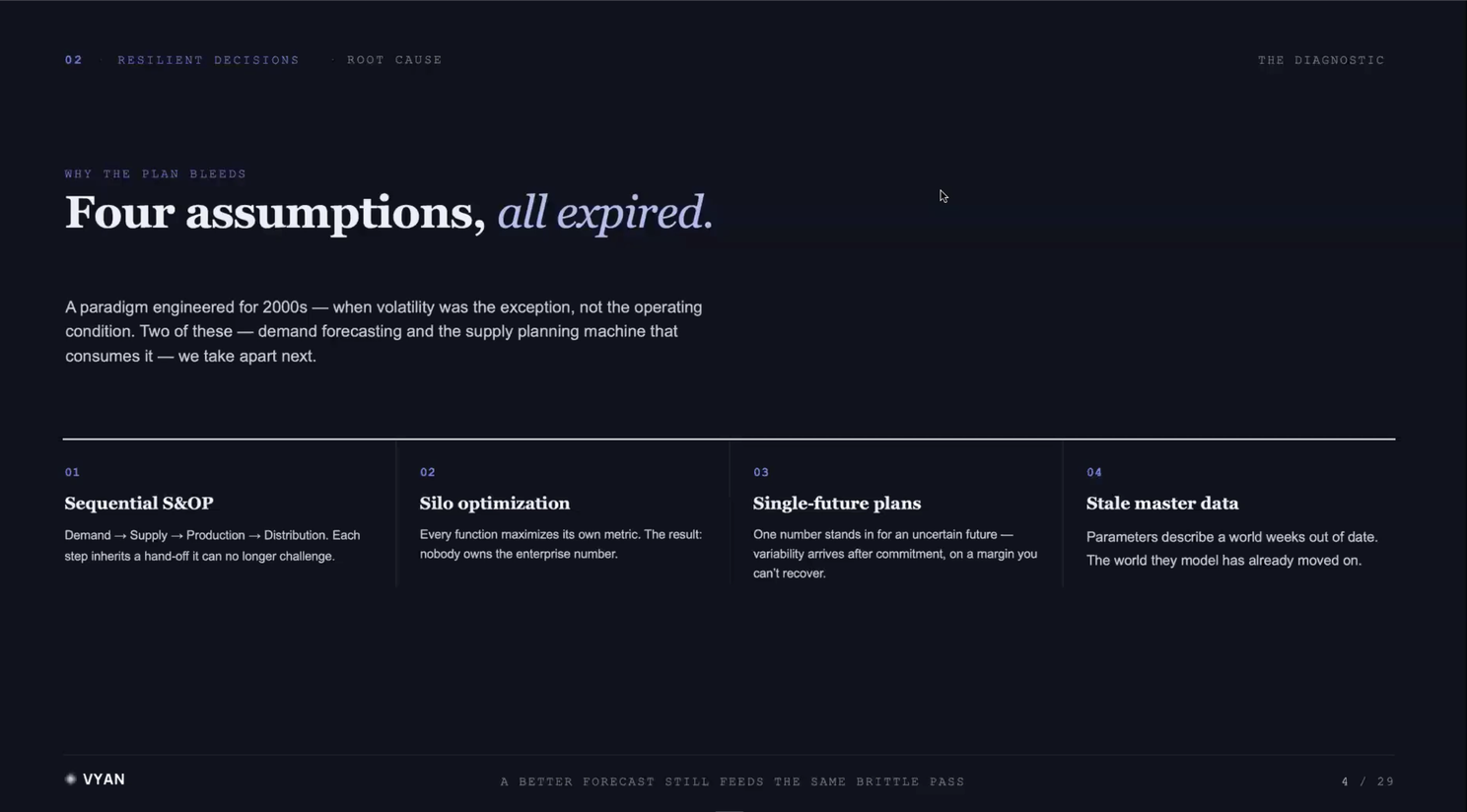
This is the deepest idea in the session, and the one everything else rests on.
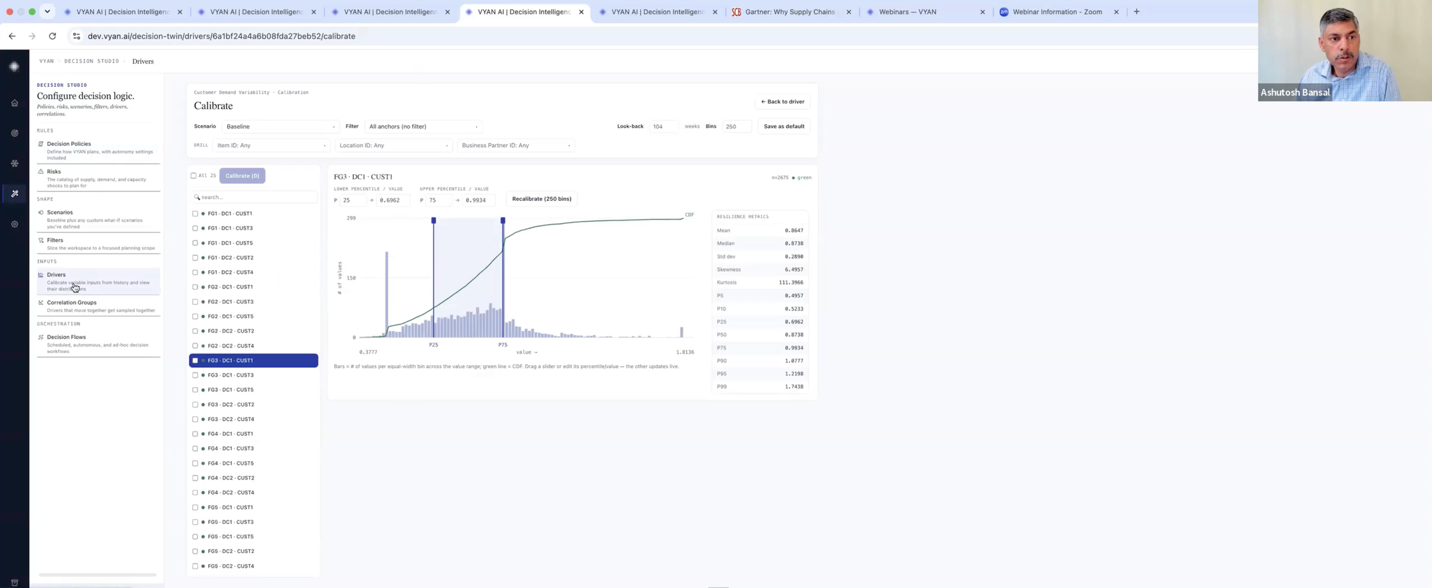
Pull the transaction history for a single supplier-and-item lead time: the same supplier, the same part. You won't see a number. You'll see a shape: sometimes bimodal, a fast lane and a slow lane; sometimes fat-tailed, where a long string of expensive days drags the average past the typical week. Take the mean of that shape and you've described a future that rarely actually happens.
Every planning parameter behaves this way: lead time, demand, yield, cost. They are distributions, not points. And once you accept that, the entire deterministic planning machine looks like what it is: a faithful amplifier of a number that was wrong to begin with.
Two engines: what could happen, and what to do about it
If drivers are shapes, planning splits into two distinct jobs.
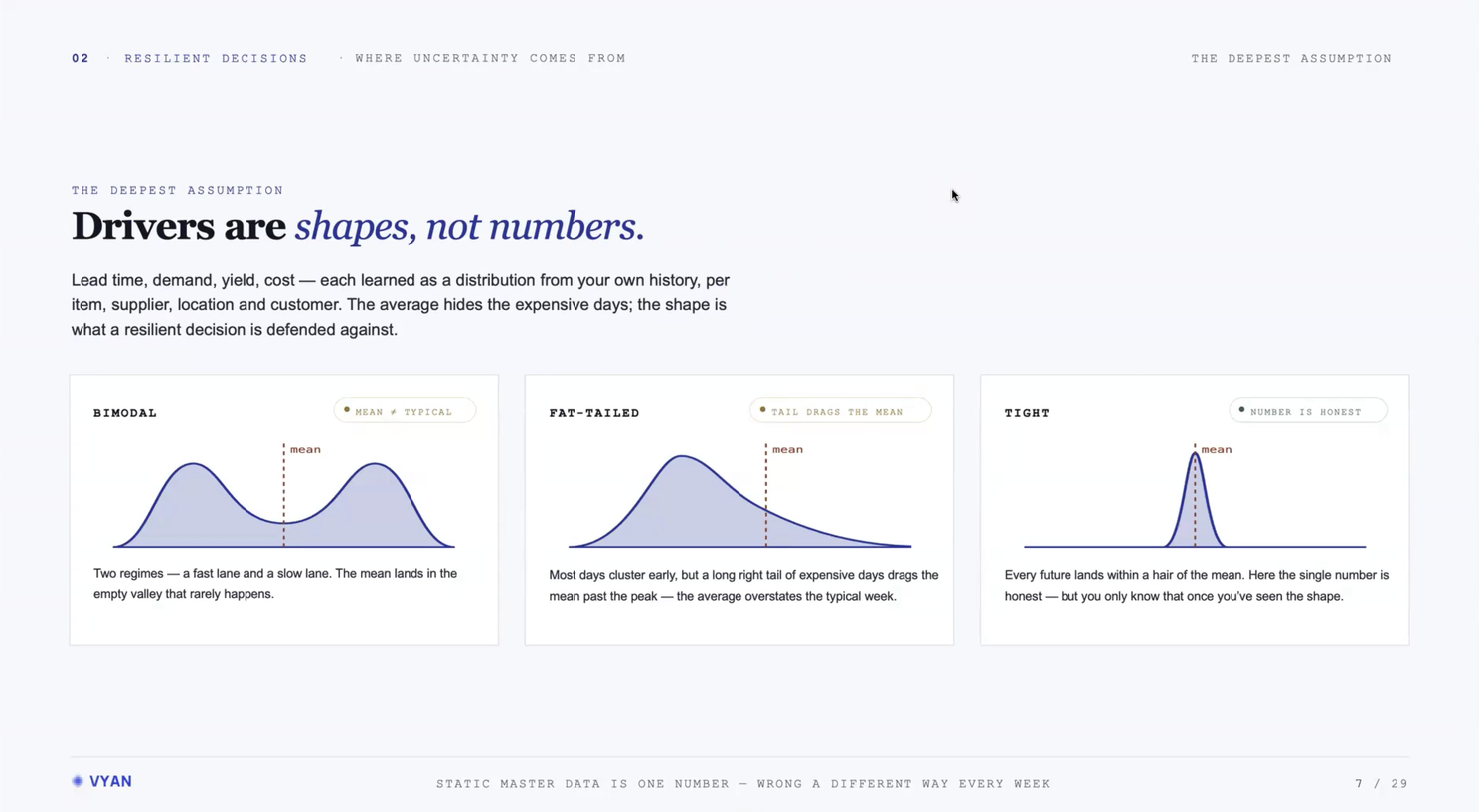
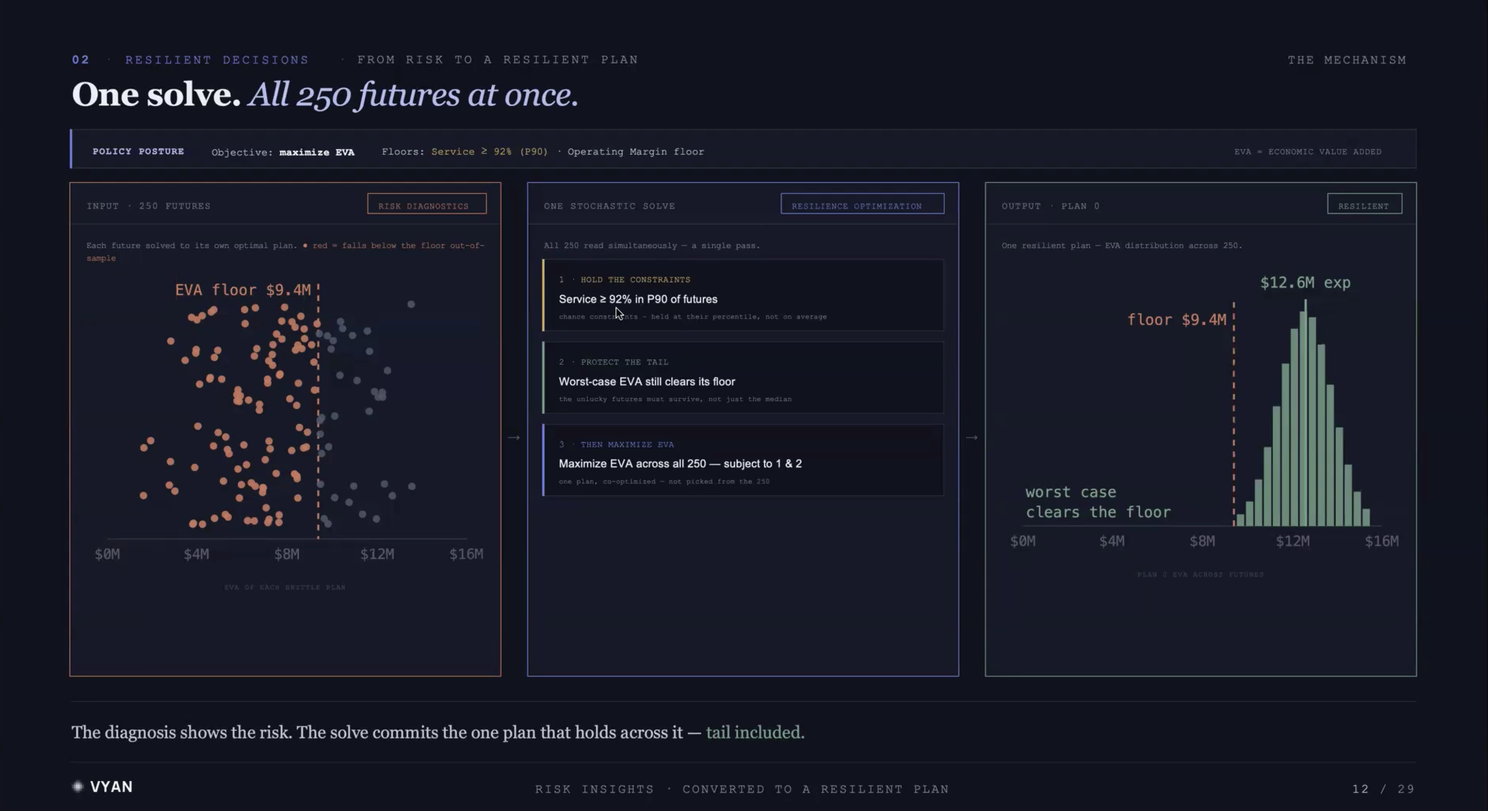
The first is the Risk Diagnostic. Instead of a planner hand-building three scenarios (best, base, worst), before the S&OP meeting (three darts on a board that can't tell you what happens when a disruption risk moves from 20% to 40% likely), the system runs hundreds of futures. In the session we ran 250, though that's just a policy parameter. Each future is a complete plan, solved under its own sampled conditions: this lead time at its 80th percentile, that demand at its 30th, a supplier disruption switched on, a port delay off. The output is the true shape of risk across every KPI you care about: revenue, margin, service, cash, economic value added.
But knowing the spread doesn't tell you what to do. Each of those 250 plans is optimal only inside its own assumptions, and you don't get to know which future you'll land in. So the second engine is Resilience Optimization: finding the single set of buy, make, move, and store actions that holds up across most of those futures, at a risk posture leadership defines. "Hold 92% service in 90% of futures, and make sure even the worst-case economic value clears its floor." That's not a forecast. It's a commitment built to survive the range.
The posture is the pivot, and it's what hands the wheel to executives. Chasing growth into a new market? Favor service; accept the margin and cash cost. Turbulent quarter? Protect cash, hold the margin floor, be willing to delay or push out negative-margin orders. Leadership stops receiving an S&OP deck after the fact and starts setting the policy the plan is built against. Executives become the decision-policy architects; planners run the decision experiments against that policy. They work as one team, and the outcome is integrated by construction.
The cost of resilience, and why it's the easiest sale to a board
A resilient plan is, by design, not the optimal plan for any single future. It gives up a little upside to never fall off a cliff. That give-up is measurable, and it's the number we put on the scorecard.
Take the resilient plan, call it Plan Zero, and back-test it against what perfect hindsight would have earned. The gap between the hindsight-perfect outcome and what Plan Zero actually delivered is the cost of resilience: the premium you pay to be safe across every future instead of lucky in one. You'd never insure a car for half its value. A few points of economic value added to never breach the floor is a premium any board will gladly approve, once they can see it written down.
A proposal is not a decision
This is the line that names the category. Some vendors call a plan output, move 500 units from this warehouse to that one, a decision. It isn't. It's a proposal: the mechanical result of a forecast run through deterministic MRP. A decision weighs the full range of futures, balances objectives in tension, carries an intent, and reasons about the value of waiting: should we act now or hold, and what does holding cost? Planning landscapes and decision landscapes are different things, and conflating them is how the industry ended up automating the wrong layer.
Which is why resilience has to come first. This is a System of Intelligence that sits above your system of planning and your system of record, it doesn't replace them. Keep your ERP. Keep the solver your team trusts. Run it inside the platform across hundreds of futures to see its resilient risk spread, and benchmark it against a plan built to survive all of them. (And to be clear: "integrated" here means solving across commercial, operations, and finance as one, not integrating with your ERP. Different word, different meaning.)
A dashboard reports the past. A scorecard explains the future.
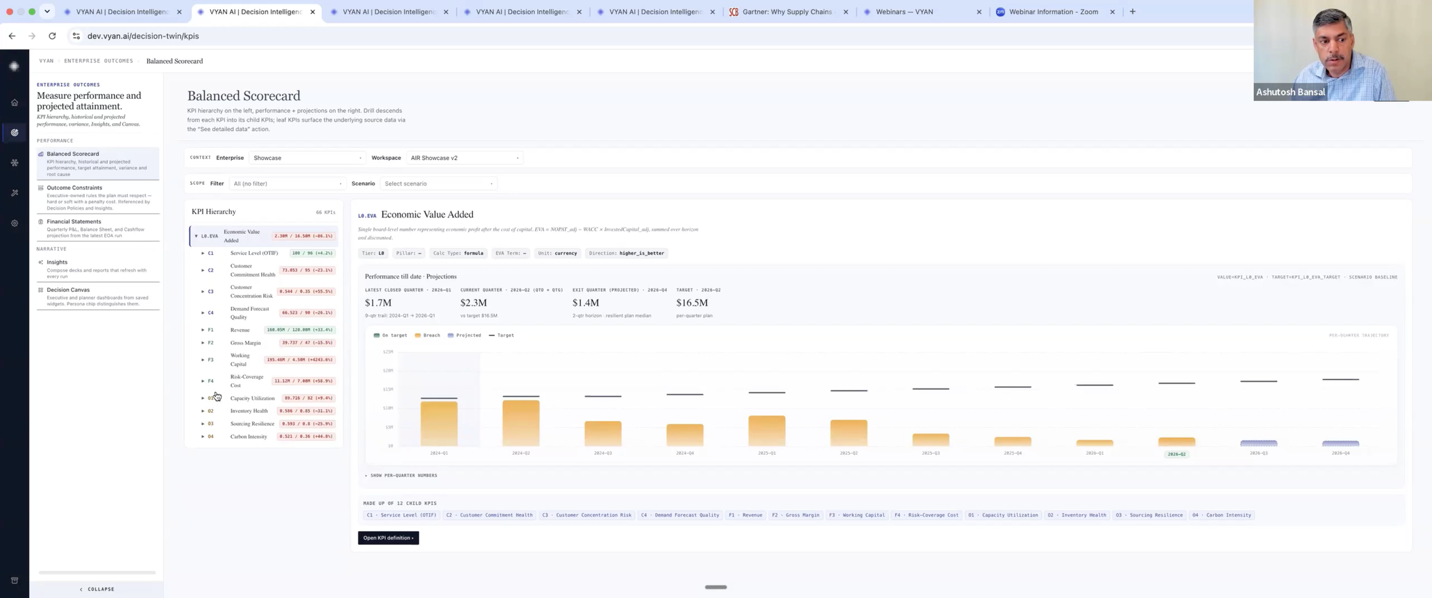
The payoff shows up in what you can finally measure. A system of record tells you what already happened. A planning system projects one future. Only a decision layer can price what uncertainty costs: the cost of resilience, the cost of forecast error split into over- versus under-forecasting, the cost of churn.
We showed this live. Enterprise economic value: green. Drill into margin by customer: most healthy, one quietly negative. Drill into that customer's order lines: there's the bleed: constant pull-ins, churn, expedite fees nobody priced. The average looked fine because the average is a place no customer actually lives. Then the system recommends the surcharge that would cover the churn, so the commercial team can finally have the real conversation.
Where this goes, and where to start
Last week was the R of A·I·R: Resilient. Autonomous (how the system acts between cycles) and Integrated (how it reasons across the enterprise) are the next two sessions, and they build directly on this one. The platform is open by design (bring your own models and agents, governed by one decision policy), because the goal is an ecosystem that compounds value, not a single-vendor lock-in.
The economics, modeled against a billion-dollar revenue book: economic value added recovered in the range of 1–3% of revenue, 20–30% less expedite and safety stock, and planning cycles that compress from weeks to hours. But the number that matters is the one computed against your last eight quarters.
That's what PULSE is: a short, CxO-level workshop that benchmarks your decision maturity, shows VYAN on problems you recognize, and ends in a preliminary business case in days, not months of slideware.
The full session and deck are at vyan.ai: recording and slides both, so you can share the argument internally: vyan.ai/resources/webinars/plans-break-policies-hold-webinar