
You’re Judging Decisions by How They Turned Out. That’s Backwards.
A plan is an instruction. A good outcome is often luck. The only thing worth grading is the call you made before the world showed its hand.
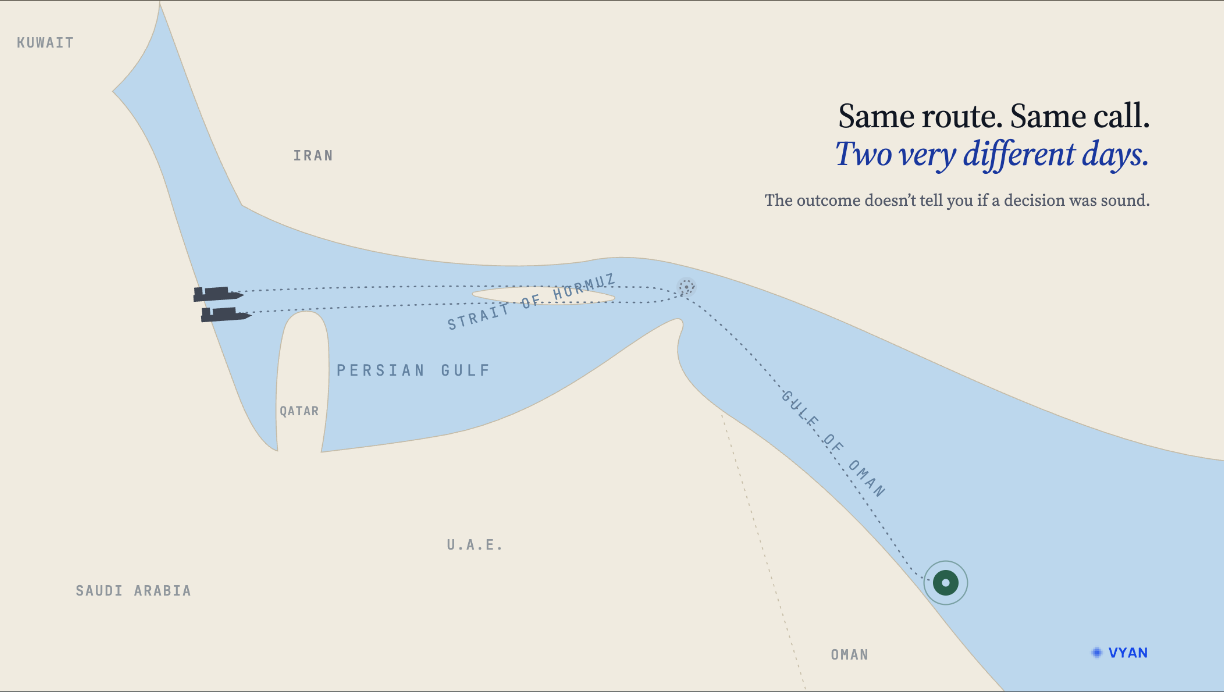
This spring, two ships were cleared to transit the Strait of Hormuz on the same day, on the same authority, along the same water. One reached port. The other was struck within hours.
Grade those two choices by how they turned out and you will praise the lucky captain and fault the unlucky one, and learn precisely the wrong thing for the next chokepoint. That is the trap. A decision is not a plan, and a good decision is not a good outcome. We grade planning teams on forecast accuracy and on how the quarter landed; neither tells you whether the decisions underneath were any good. To see why, it helps to be precise about two things we usually leave fuzzy: what a decision actually is, and what makes one good independent of how it turned out. The Strait of Hormuz has spent four months running a live seminar on both.
What the Strait is actually asking of planners
Since late February, traffic through the Strait of Hormuz, the only sea route out of the Gulf and in peacetime about a quarter of the world’s seaborne oil, has lurched between closed, partly open, and closed again. Iran declared it shut; ships transited anyway, some running dark with their transponders off. A fourteen-point memorandum signed in mid-June was meant to reopen it toll-free for sixty days, and within days oil flows hit a single-day record. The agreement began unraveling almost at once. By the weekend of June 27 a drone had struck a crude tanker near the strait; the US answered with strikes on Iranian sites on and around the waterway; and on June 28 Iran fired missiles and drones at US bases in Kuwait and Bahrain, killing a civilian in the Gulf and drawing condemnation from every neighbor. Tehran threatened to walk out of the talks. Washington said the talks were still on track. Both were stated on the same day, and a planner had to commit without knowing which one the world would honor.
Strip away the geopolitics and look at the shape of the problem, because it is the purest decision any of us has seen in years. The options were all bad and none was stable: pre-position inventory at a known carrying cost, switch to costlier non-Gulf sourcing, pay the transit toll, sail dark, or wait. The uncertainty was not the ordinary kind you smooth with a better model; it was driven by adversaries reacting to each other, so no forecast survived the week, sometimes not the day. The commitment cost was severe and slow to unwind. And the window kept opening and closing: some Gulf producers tripled exports in the days before the strikes to get ahead of it, while firms that waited for clarity found it had shut on them.
The anatomy of a decision, and why most planning never reaches it
That is what a decision looks like with the lights on. It needs genuine options, real uncertainty about each, a cost to committing you cannot cheaply reverse, an objective, constraints, a closing window, and an owner who carries the consequence. Remove any one and there is nothing to decide, only a calculation to run.
Here is the line that matters. “Move 100 units from DC-3 to DC-7” is a plan. Committing two months of alternate-sourced inventory in March because the Strait might stay shut, knowing you cannot unwind it if it reopens, is a decision. Conventional planning collapses the uncertainty into a single most-likely forecast, picks the plan that is optimal for that one assumed future, and treats it as free to redo next month. In doing so it quietly violates three of the conditions that made this a decision: the uncertainty, the commitment cost, and the window. It does not make the call. It assumes the call away and hands you an instruction.
A good decision is not a good outcome
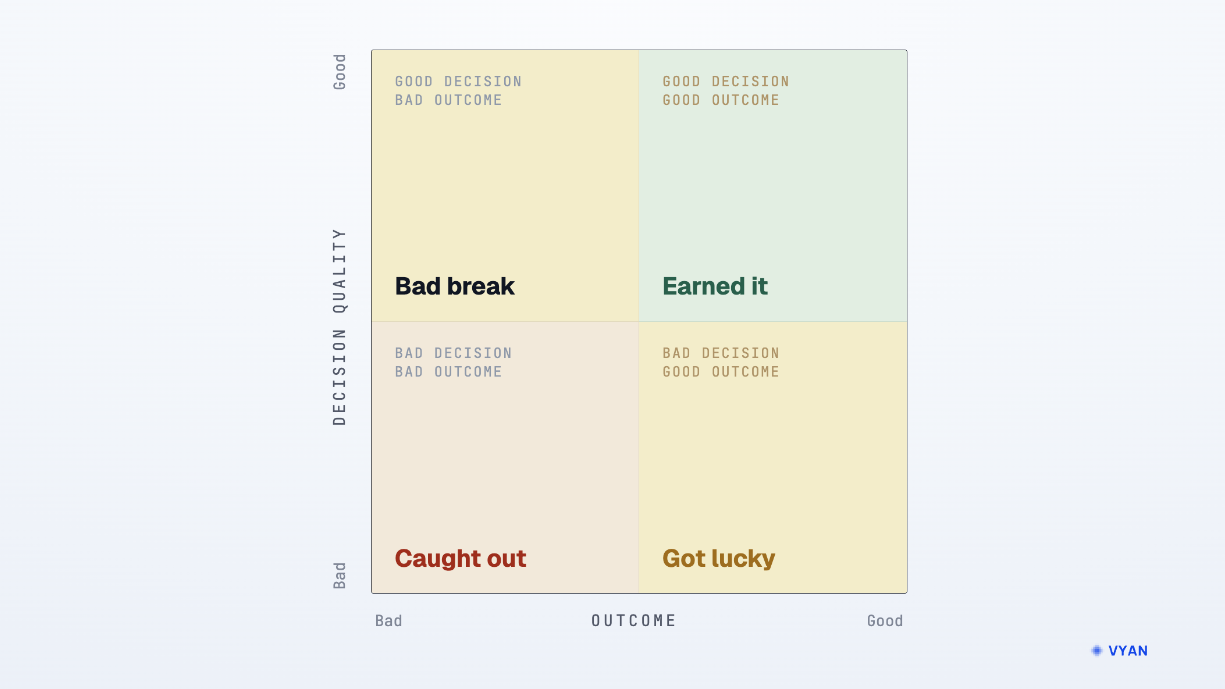
Now the question almost nobody in the planning-software conversation will answer plainly: what makes a decision good? The reflex is to look at the result. But a decision is made before the result exists, with only what was knowable at the time. A good decision is one that was correct to make given that information, not one that happened to land well.
The Strait made this brutally concrete, and kept making it. When the memorandum was signed and flows hit a record, the obvious read was that the worst had passed: stand down the hedges, resume routing. Inside two weeks that read was in ruins, a tanker strike, US strikes on the waterway itself, Iranian missiles into Kuwait and Bahrain. The firms that treated a favorable fortnight as a settled outcome were not careless; they were doing exactly what single-future planning rewards. And the trap tightened in a way no forecast could price: under the deal Iran insists vessels use only its designated corridor and calls any other route a violation, while the US has widened a competing lane near Oman. Picking a route stopped being about distance and cost. It became a question of which adversary to cross, on a map where both lanes are contested and the safe one changes by the day.
It runs the other way too. Some shippers went dark, ran cargo through, and made port. Other vessels were waved through one morning and hit by afternoon. In several cases the decision to transit was essentially identical; the outcomes diverged on factors no planner could have known at the moment of commitment. Grade those by outcome and you will praise recklessness that got lucky and punish prudence that got unlucky. We saw the milder version in the 2025 tariff whipsaw: tariffs announced, then paused within a week. Importers who front-loaded to beat the deadline looked smart for a fortnight, then spent the year carrying more inventory than they wanted at compressed margins, wishing they had diversified instead. The forecast was sometimes right. The decision was still expensive.
What separates a good decision: one method, wearing three faces
Some attributes are table stakes: a good decision serves a clear objective, respects real constraints, and has an owner who can defend it by pointing to what was known at the time, not to how it turned out. The parts that actually decide who survives a Strait-of-Hormuz spring are less discussed, and they turn out to be the same move seen from three angles.
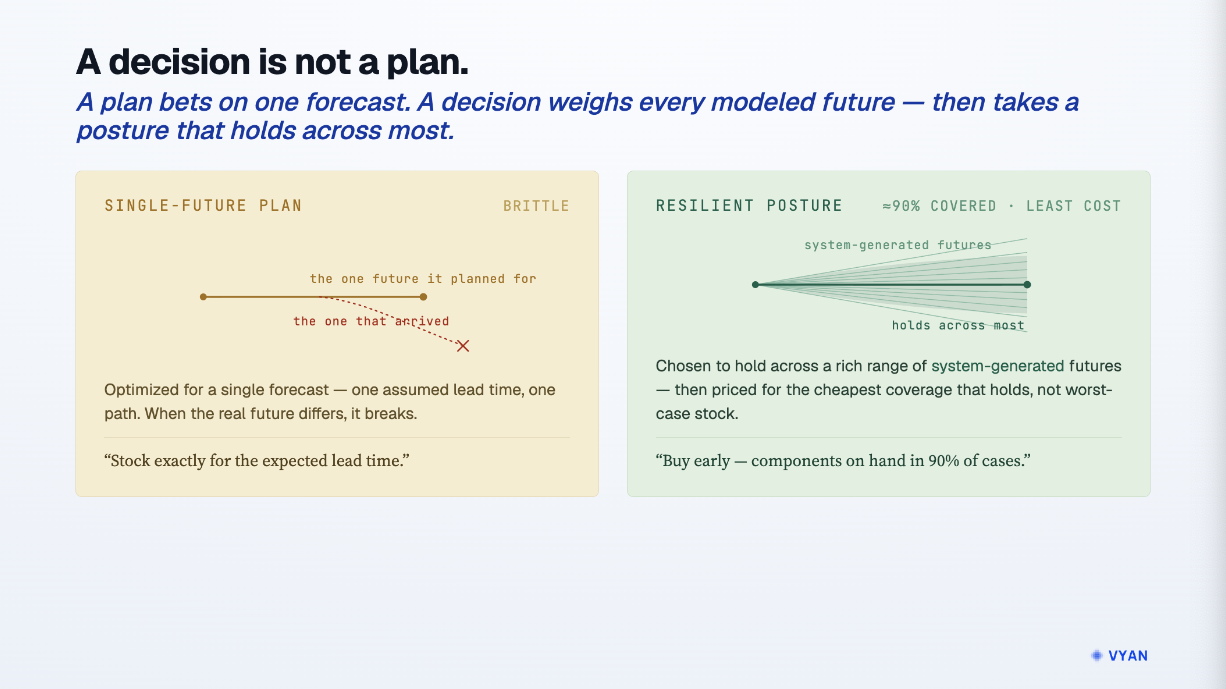
It is resilient across the futures, not optimal for one of them. A good decision holds up across the range of outcomes that were genuinely foreseeable, rather than being perfect for the single future someone assumed. The firms that locked one rigid bet, “it stays open” or equally “it stays shut,” were the most exposed each time the world moved, and it moved repeatedly. Optimality for a guess is fragility wearing a confident face.
It is made at the right moment, and treats waiting as a priced choice. There is real value in waiting when waiting buys information, and a real cost when the window is closing. Gulf producers who moved oil early read the window correctly; importers who waited for the Strait to “clarify” found it had shut. A good decision knows which situation it is in and prices the wait either way.
And it pays only as much for protection as the protection is worth. Resilience sounds like a luxury, hedge everything and watch the cash evaporate, which is exactly what over-hedging did to the importers who drowned in inventory. But in the Strait the cost of resilience was not a vibe; it was a line on an invoice. War-risk insurance, roughly an eighth of a percent of hull value before the war, was being quoted at several percent at the worst of it, as much as twenty times the peacetime rate and millions of dollars on a single large tanker. Every hedge carried a visible price, and the discipline was to buy the ones whose protection exceeded their premium and decline the rest.
Those are not three separate virtues. They are one calculation: weight the futures you can already see, price each hedge against the protection it actually buys, and choose the posture that holds up across the range at a cost worth paying. That posture is not a plan for the future you guessed. It is a policy for the futures you didn’t.
Velocity is not the answer
It is fashionable to say the fix is speed, agents deciding in milliseconds, the planning cycle compressed from weeks to moments. Speed is useful for the routine. But against a problem like the Strait, velocity without resilience just lets you commit to the wrong thing faster. Re-deciding hourly on a single-future basis is not the same as deciding once, well, across the futures you can already see. The bottleneck was never how fast a planner could act. It was whether the thing they committed to would survive a different Tuesday.
The question that replaces the forecast
Volatility is the operating environment now, not the exception. The Strait will resolve and something structurally identical will take its place: a tariff regime shifting from executive order to legislative timeline, a sourcing map redrawn under duress and frozen by sunk cost, the next chokepoint. In that world the advantage does not go to the most accurate forecast or the busiest scenario engine. It goes to whoever can do the thing our tools were never built to do: commit to a posture that survives most of the futures already in view, show the price they paid for that resilience and why it was worth it, and defend the call on what was known the day it was made, not on how the week happened to break. Most planning still cannot tell you that. It hands you the most likely future and the plan optimal for it, and calls the instruction a decision.
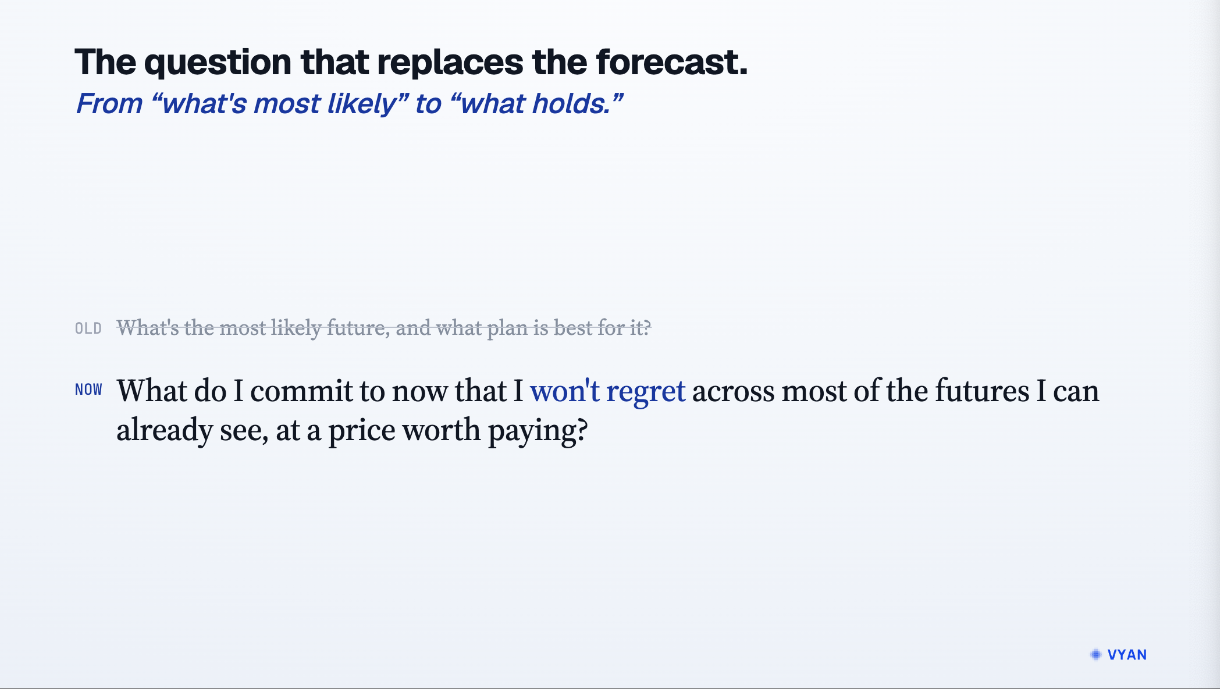
So the question stops being “what is the most likely future, and what plan is best for it,” and becomes “what do I commit to now that I will not regret across most of the futures I can already see, at a price worth paying.” That is a different question entirely. And once you have asked it properly, you cannot go back to calling an instruction a decision.
So here is the question I would put to anyone still grading their planners on last quarter's forecast accuracy and business performance: what would it take to grade the decisions instead, on what was knowable the day they were made? I am curious how you would answer.